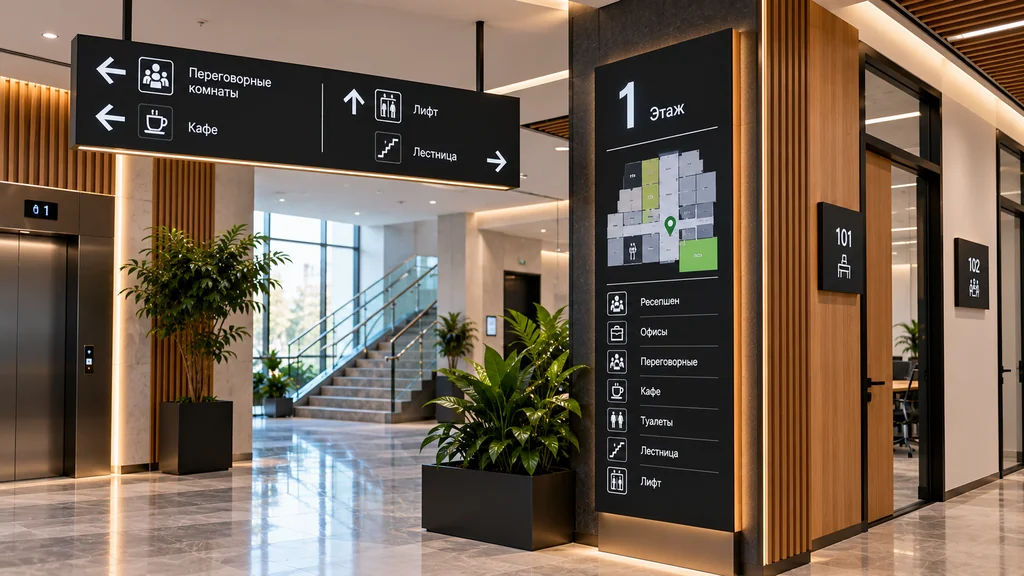
Indoor Navigation in Tashkent: How to Choose and Order
Indoor navigation is a set of signs, schemes, plaques, pictograms, and digital maps that guide a person from the entrance to their desired destination without staff assistance. It includes physical signs, color zoning, tactile elements for visitors with limited mobility, and evacuation signs. The choice of a solution depends on the building type, foot traffic, and budget.
Why Indoor Navigation is Needed: Data and Risks
The scale of the task is massive. According to CMWP estimates for September 2026, Tashkent’s office stock is 1.02 million sq. m, and quality retail space in the city is about 514,000 sq. m. Add clinics, schools, and hotels, and you get thousands of premises where people need to quickly understand where to go.
There is also a legal side. According to clarifications by the Huquq Plus portal regarding Law No. 641 “On the Rights of Persons with Disabilities, public buildings must accommodate the needs of people with disabilities regardless of ownership type. Such conditions are deemed a “mandatory part of construction projects.” For violations, a manager or owner can face a fine under Article 511 of the Code of Administrative Offenses ranging from 10 to 15 Basic Calculation Values (BRV), which is 4,120,000 to 6,180,000 UZS. At an exchange rate of about 11,960 UZS per dollar, this is approximately 344–517.
People’s behavior in buildings has also been well-studied. A VR experiment by Delft University of Technology with four tasks in a multi-story building (Feng, TU Delft) demonstrated that at decision-making points, a person actively gathers information to choose their next step. This means a sign is needed exactly at the fork in the path, not just wherever it is convenient to mount.
The Author’s Method: Three Visitor Questions
At every point of the route, a person asks three questions: Where am I? Where should I go? How do I get back? Walk through your building through the eyes of a newcomer and mark the places where at least one of these questions remains unanswered. This becomes your list of navigation points, which forms the basis for the cost estimate.
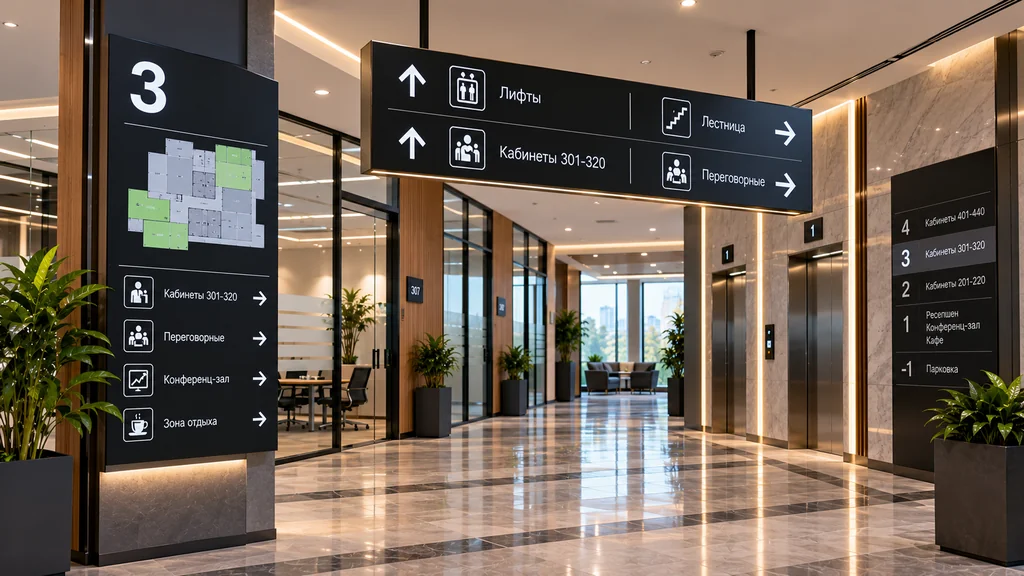
Types of Indoor Navigation and Selection by Building Type
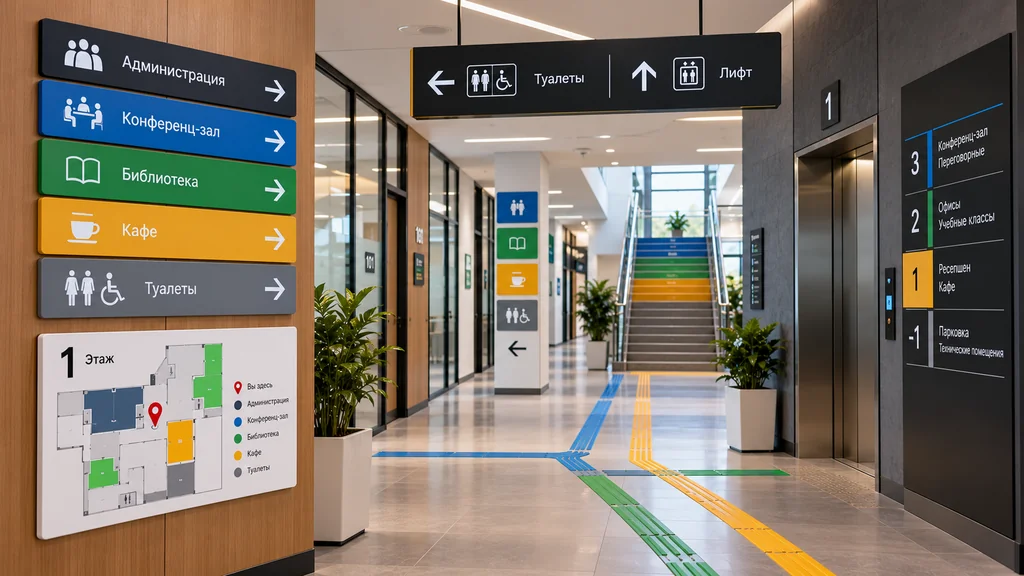
Physical navigation includes plaques, projecting and suspended signs, window films, floor plans, and evacuation signs. Digital navigation involves interactive terminals, screens, and electronic maps. For most facilities in Tashkent, it makes sense to start with a physical system and add a digital layer if the building is large and the tenant mix changes frequently. Formats and solution examples can be found in the premises branding and decoration services section.
| Building Type | What is Important | Main Elements | What to Pay Attention To |
| Office | Quick search for offices and meeting rooms | Plaques, projecting signs, window films | Uniform style, interchangeable inserts |
| Shopping Center | High traffic, tenant rotation | Pylons, suspended signs, “You are here” maps | Easy updates after store changes |
| Clinic | People in stress, elderly visitors | Large pictograms, color-coded lines, schemes | High contrast, simple wording |
| School and University | Children, guests, exams | Room numbers, floor plans | Material durability |
| Hotel | Foreign guests, accessibility | Multilingual signs, room numbers | Duplication in multiple languages |
How to Choose a Solution and How Much Navigation Costs
There is no single price: the set is tailored to the layout. The estimate is calculated after measurements and a brief, once the locations, materials, and installation conditions are finalized. The final cost is influenced by four factors:
- Area, number of floors, and the total number of installation points.
- Materials, lighting, and mounting method (on glass, drywall, or concrete).
- Custom design based on a brand book and production volume.
- Installation conditions: height, night work, and building regulations.
How Not to Overpay
First, map out the installation points, and only then choose the materials. For frequently changing text, use interchangeable inserts; for everything else, use a single template across all floors. A digital terminal isn’t justified everywhere: if the building is compact, clear physical signs are entirely sufficient.
Step-by-Step Plan: How to Implement Navigation
- Walk through the building through the eyes of a newcomer and mark points where orientation is lost.
- Mark forks, elevators, stairs, and zone entrances on the floor plans.
- Coordinate the rules with the management company or building owner.
- Approve layouts according to your brand book: fonts, colors, pictograms.
- Order production and installation on a unified schedule.
- Do a second walkthrough to eliminate any remaining “blind spots.”
Accessibility and Language of Signs
Law No. 641 highlights information accessibility in a separate article (Art. 26). Therefore, plan for high-contrast signs, large fonts, and tactile elements where necessary; verify specific tactile sign requirements with your designer. Article 20 of the “On State Language” Law requires signs, announcements, and price tags to be in the state language (Uzbek), allowing duplication in other languages. For common areas, plan for Uzbek as the main text, with Russian and English as secondary levels; clarify exact details with a legal advisor.
Regional Specifics: Tashkent and Other Cities
Tashkent
The capital has many multi-story business centers and shopping complexes, and management companies often dictate their own strict rules for signage. Approve your layouts in advance, otherwise, the installation will face delays.
Samarkand, Bukhara, Andijan, and Other Cities
In tourist hubs, the focus is on multilingual signs in hotels and museums. The law requires a hotel to have at least one room accessible for wheelchair users, as well as displays and voice devices for people with hearing and vision impairments. For retail or hotel chains with regional branches, it is most convenient to utilize a single design guide and handle installation locally.
Typical Mistakes
- Signs placed only at the entrance, without reinforcements at forks.
- Small text and low contrast: readable only from up close.
- No updates made after relocations or tenant changes.
See examples of premises decoration in our case studies.
Frequently Asked Questions
Does a small space need navigation?
Yes, at a bare minimum: a sign at the entrance, door plaques, and an evacuation plan.
Can we rely only on digital navigation?
It is better to combine them: physical signs always work, while a digital layer helps primarily in large buildings.
At what height should signs be placed?
The general guideline is eye level, about 150 cm from the floor; exact heights are specified in the project documentation.
How do you update signs?
Use interchangeable inserts and modular profiles: you change the paper/plastic insert, not the entire structure.
How soon will the set be ready?
The timeframe depends on the number of points and selected materials, and is confirmed after layout approval.
Order Navigation for Your Premises
Tell us about your building type, area, and number of floors — we will prepare a point layout scheme and a cost estimate. Contact us to get a quote for your premises in Tashkent or any other city in Uzbekistan.

Related Posts
Exhibition Stand Construction in Tashkent — From Concept to Installation
Exhibition stand construction is a comprehensive service that covers the creation of a space for presenting a company at an…

Buy an Exhibition Stand in Tashkent — How to Choose and Order
An exhibition stand is more than just a structure with a company logo. It is a space for presenting products,…
Office Branding in Tashkent: Creating a Strong Company Image
Office branding is the process of designing a workspace in the company’s unified visual style using a logo, corporate colors,…

REQUEST A CALL
Leave a request. Our managers will contact you soon and calculate the cost of your project.