Shopping Mall Navigation in Tashkent: Layout, Price, Installation
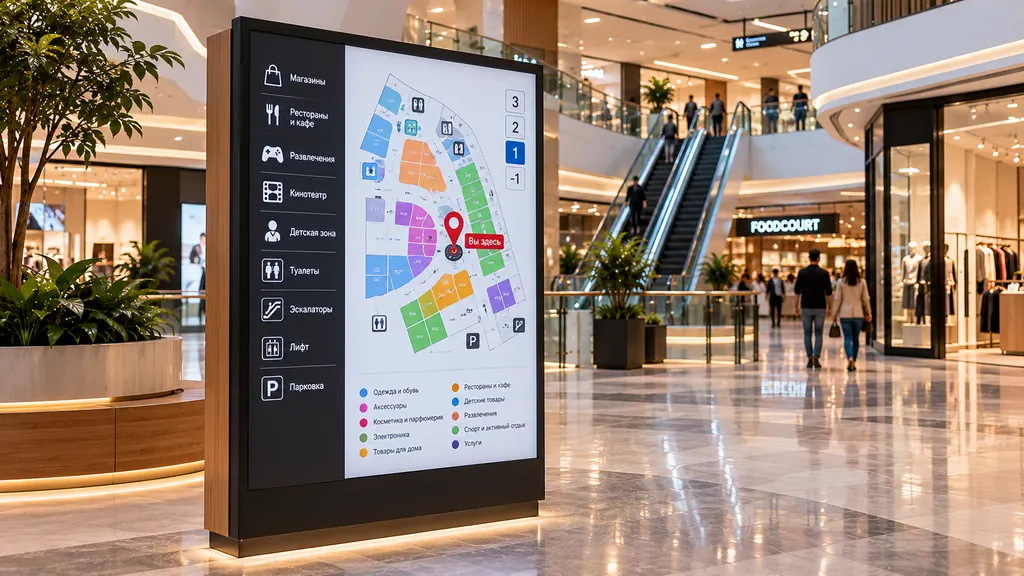
Shopping mall navigation is a system of directional signs, floor plans, door plates and color zones that helps visitors quickly find a store, restroom, parking or exit. It includes stelae, hanging and wall-mounted signs, “You are here” maps and evacuation signs. The price depends on the area, the number of floors, materials and the number of sign points.
Why a Shopping Mall Needs Navigation: Tashkent Market Data
According to CMWP data published in Spot in January 2026, Tashkent has 24 quality shopping malls with a total leasable area of about 514,000 sq. m, and the vacancy rate is about 18%. Only five malls keep vacancy at a healthy level of 5% or below. CMWP expert Lilia Eremenko sums it up: “there are many malls, but very few successful ones.” So visitors choose the center where they feel comfortable, and ten minutes lost looking for a cafe or a restroom easily turns into a reluctance to come back.
Research supports this. In a study by Dogu and Erkip (2000) of a shopping mall in Turkey (Bilkent University), visitors found the signage system insufficient. The building seemed simple to them, but restrooms, phone booths and stores out of direct sight were the hardest to find. In other words, the problem is not the size of the mall but the points where a person needs a hint.
Our Calculation: The Price of Lost Minutes
Suppose a mall has 10,000 visitors a day, and 10% of them get lost at least once, losing 4 minutes each. That is 4,000 minutes, or about 67 hours a day, that did not go to shopping, coffee or the cinema. The calculation is illustrative, but it shows the scale: plug in the counter data from your own mall.
What Shopping Mall Navigation Consists Of
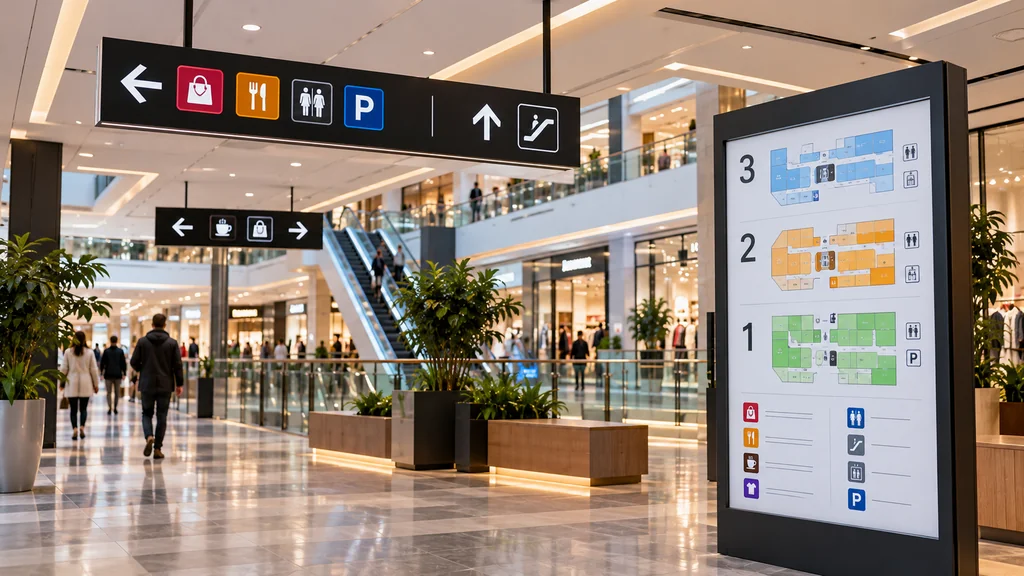
The system follows the visitor’s route, from the parking lot to the food court and the exit. Ready-made formats and solutions are collected in the section on branding and commercial space design services.
Four Levels of Navigation
- Street and parking: stelae, entrance signs, zone and level numbering.
- Entrance groups and atrium: “You are here” maps, store directories, hanging signs.
- Floors and connections: color coding, pictograms by escalators and elevators.
- Services and safety: restrooms, food court, cinema, evacuation plans and signs.
Materials and Installation Points
| Element | Material | Where to install | What affects the price |
| Stele and pylon | Metal, composite, lighting | Entrance, parking, main door | Height, lighting, foundation |
| Hanging sign | Aluminum, acrylic | Atrium, central galleries | Size, ceiling mounting |
| “You are here” map | Glass, PVC, replaceable insert | Entrances, escalators | Format, ability to update |
| Pictograms | Film, acrylic | Restrooms, food court, elevators | Quantity, layout complexity |
| Evacuation signs | Photoluminescent film | Exits, corridors | Format, compliance with regulations |
How Much Navigation for a Shopping Mall Costs
There is no single price: the set is assembled for the floor plan, the number of floors and the flow of people. The estimate is calculated after measurement and a brief, once the points, materials and installation conditions are known. Four factors affect the total:
- the mall’s area, number of floors and number of installation points;
- materials, lighting and the method of fixing to ceilings and glass;
- custom design based on the brand book, and the quantity of pictograms;
- installation conditions: height, night work, the mall’s operating hours.
How Not to Overpay
Tenants in a mall change, and the names on maps and directories change with them. According to CMWP experts, the management company prepares tenant regulations in advance, including rules for signs and storefronts, and the decision to relaunch a mall is based on footfall, tenant revenue and turnover. So build in replaceable inserts and modular profiles: only the store name is updated, not the whole structure.
Step-by-Step Plan: How to Implement Navigation
- Run a first-visit test: ask someone who has never been to the mall to find a store, a restroom and an exit, and note where they stopped.
- Mark junctions, escalators, elevators and zone entrances on the floor plans.
- Agree on the management company’s and tenants’ requirements for signs.
- Approve layouts based on the brand book: font, colors, pictograms.
- Order production and installation on a schedule that does not disrupt the mall.
- Repeat the test and update the inserts whenever tenants change.
Language of Signs
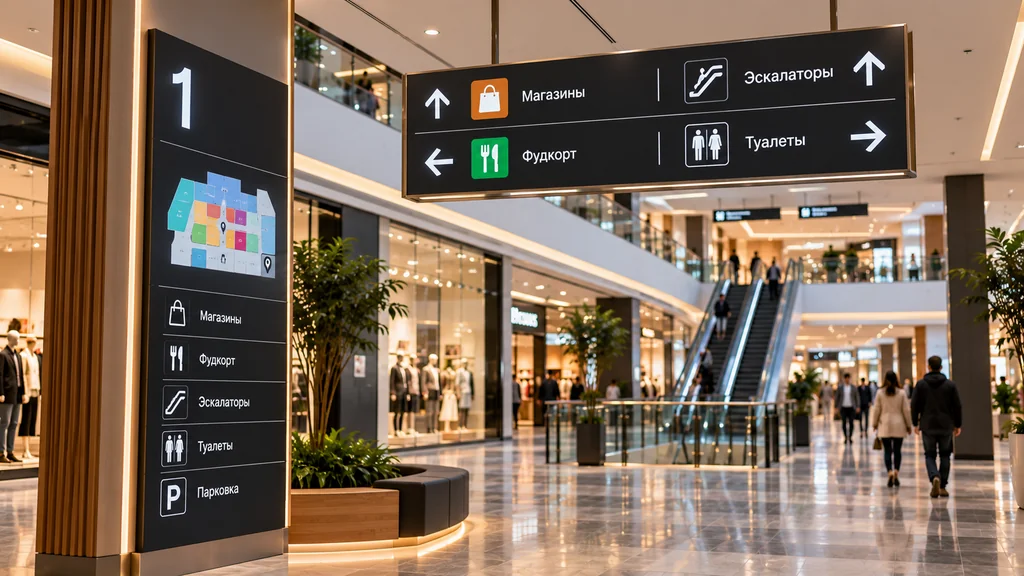
Article 20 of the Law “On the State Language” requires signboards, notices and price tags to be written in the state language, while allowing duplication in other languages. In Tashkent and Bukhara, district administrations have checked signs for compliance with this law. For the mall’s common areas, make Uzbek the main text and Russian and English a secondary layer; confirm the details with a lawyer.
Regional Specifics: Tashkent and Other Cities
Tashkent
According to CMWP, only two of the capital’s malls, Tashkent City Mall and High Town Mall, have a leasable area of 50,000 sq. m or more, while 18 of the 24 quality malls fall short of 30,000 sq. m. Large centers focus on the atrium, hanging signs and digital maps; compact ones need only clear entrance groups, a “You are here” map and pictograms on each floor.
Samarkand, Bukhara, Andijan and Other Cities
For chains and developers with several properties, a single standard matters more: one design guide, replicated layouts and on-site installation. That way a visitor reads the navigation the same way in any city, and when a crew travels, delivery, schedule and access to the mall are agreed in advance.
Common Mistakes
- Signs only at the entrances, with no repeats at junctions and by escalators.
- Small text and weak contrast: readable only up close.
- Maps and directories that are not updated after tenants change.
See examples of commercial space design in our case studies.
Frequently Asked Questions
Does a small shopping mall need navigation?
Yes, at a minimum: signs from the parking lot, a “You are here” map at the entrance and signs to restrooms, the food court and exits.
Who is responsible for tenants’ signs?
As a rule, the tenant, but under the mall management company’s rules; the overall navigation is ordered by the owner or the management company.
How do I update maps when tenants change?
Use replaceable inserts and modular profiles: only the store name is replaced.
At what height should signs be placed?
At eye level and in the field of view from escalators and junctions; exact sizes and height are fixed in the project.
How long until the set is ready?
The timeline depends on the number of points, materials and the installation schedule, and is given after the layouts are approved.
Order Navigation for Your Shopping Mall
Tell us the area, the number of floors and entrances, and we will prepare a map of sign points and a quote. Contact us and get an estimate for a shopping mall in Tashkent or another city in Uzbekistan.

Related Posts
Photo Exhibition Stands in Tashkent — How to Choose and Order
Photo exhibition stands do more than simply display photographs — they help create a cohesive exhibition, attract visitors’ attention and…
The Facade as Part of the Brand in Tashkent: Why Design Matters
The facade of a commercial facility is one of the most prominent visual communication tools for a business. It shapes…

Why Outdoor Advertising Still Works Better Than You Think
Despite the rise of digital tools, outdoor advertising remains one of the strongest ways for a brand to establish its…

REQUEST A CALL
Leave a request. Our managers will contact you soon and calculate the cost of your project.