


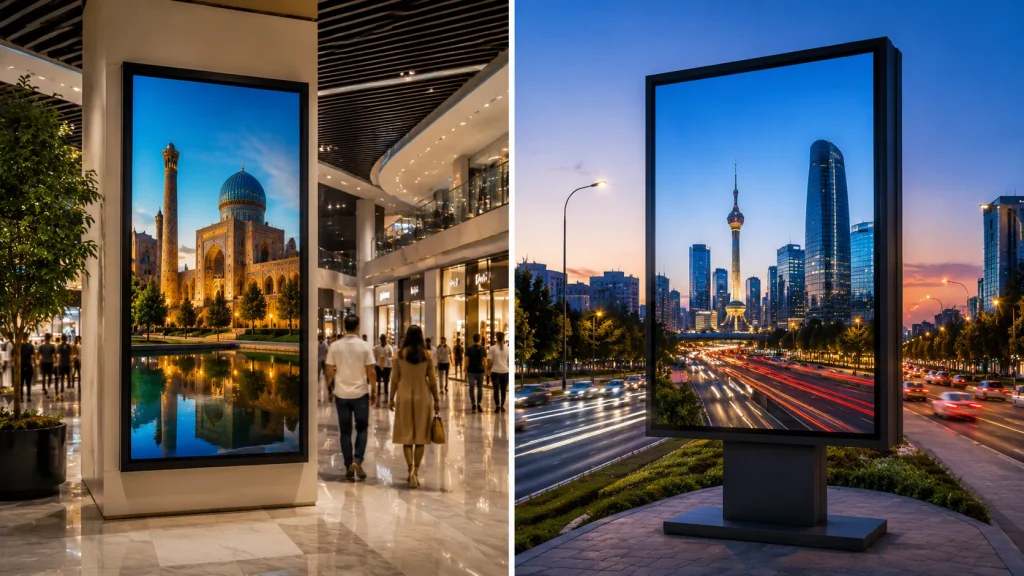
Indoor and Outdoor Advertising in Uzbekistan and Tashkent
Indoor and outdoor advertising in Uzbekistan is evolving rapidly in 2025–2026. The industry is moving beyond simple media placement toward becoming a strategic business growth tool. The market continues to expand, DOOH is becoming increasingly important, and businesses in Tashkent and across the regions are demanding measurable reach and return on investment. Below is a strategic overview to help you make informed advertising decisions.
What This Article Covers
- What indoor advertising is and how it differs from outdoor advertising
- What outdoor advertising is: modern formats in Uzbekistan
- A strategic interpretation of outdoor advertising
- Market growth in 2025 and the impact of digitalization
- DOOH and the transformation of traditional advertising structures
- How to measure advertising effectiveness using key metrics
- Regional differences: Tashkent vs. other regions
- How to choose the right advertising format for your business
- A step-by-step guide to launching an advertising campaign
What Is Indoor Advertising? Formats and Features
Indoor Advertising in Shopping Malls, Business Centers, and Airports
Indoor advertising refers to advertising placed inside buildings where audience flow is controlled and viewing time is predictable. Unlike outdoor advertising, where people usually pass by within seconds, indoor environments allow audiences to spend more time in the space—shopping, waiting for meetings, or preparing for flights.
The main indoor advertising formats include:
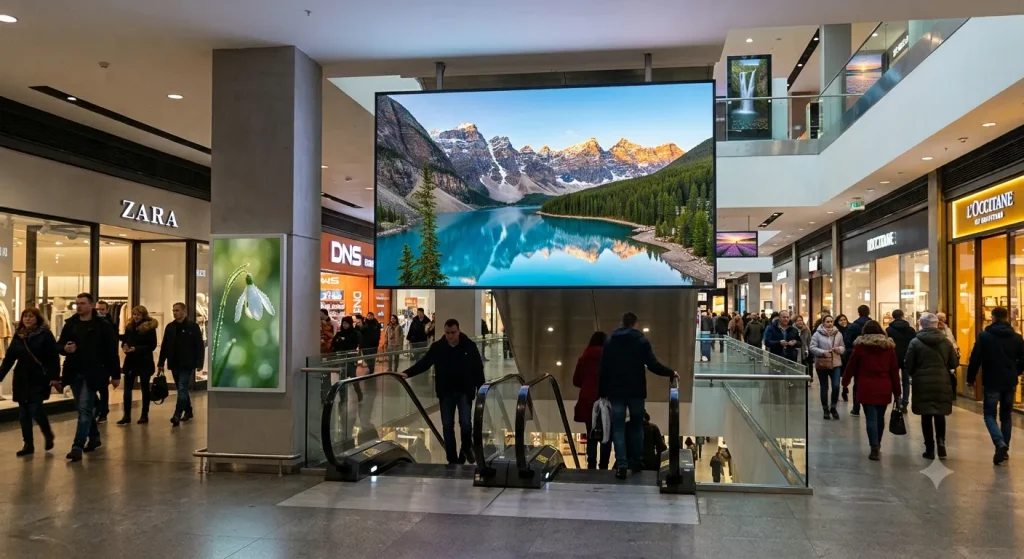
- LED media walls and atrium displays inside shopping malls;
- Digital screens near entrances and escalators;
- Branding of waiting areas, elevator lobbies, and food courts;
- Interactive displays and digital wayfinding screens.
The main advantage of indoor advertising is longer audience exposure and greater attention. Indoor environments contain less visual clutter than city streets, increasing the likelihood that advertising messages will be noticed and remembered.
From a marketing funnel perspective, indoor advertising is most effective during the consideration and decision-making stages. If the retail outlet is located within the same venue, the transition from advertising exposure to purchase becomes almost immediate.
Benefits of Indoor Advertising for Local Businesses
Location-Based Targeting
Indoor advertising enables businesses to reach audiences within a specific district, shopping mall, or business complex. This is particularly valuable for companies operating physical stores or service locations.
Higher Audience Engagement
People spend more time indoors, allowing advertising messages to receive greater attention. This reduces advertising fatigue and increases brand recall.
Integration with Digital Campaigns
QR codes, messaging apps, personalized offers, and promotional codes make it possible to connect offline advertising with online analytics and accurately measure campaign performance.
Regional Analysis
Tashkent
Tashkent is Uzbekistan’s largest indoor advertising market, offering the country’s highest concentration of shopping malls and business centers. Stable visitor traffic and above-average purchasing power make indoor advertising especially effective for premium brands and service-oriented businesses.
Samarkand and Bukhara
These cities benefit from a strong tourism sector. Advertising near hotels, airports, and central shopping districts performs particularly well because visitors are highly receptive to new products and services.
Fergana, Andijan, and Namangan
These cities are characterized by well-developed retail clusters. Here, repeated exposure and local brand recognition within individual districts play a significant role in campaign effectiveness.
Nukus and Karshi
Although these cities offer fewer advertising locations, they also have lower competition for audience attention. Carefully selected placements can deliver strong results while keeping advertising costs relatively moderate.
Outdoor Advertising: Scale and Reach
What Is Outdoor Advertising? The Main Formats in 2025
Outdoor advertising refers to advertising placed in urban environments to reach a broad audience. In 2025, it remains one of the key tools for brand awareness and mass promotion in Uzbekistan.
The most popular formats include:
Billboards
Traditional roadside billboards located along major roads and in residential areas. They are effective for increasing brand awareness and repeated audience exposure, especially during long-term campaigns.
Superboards
Large-format advertising structures installed at city entrances and along high-speed highways. They are widely used for large-scale campaigns by banks, real estate developers, and telecommunications companies.
LED Screens
Digital billboards located in central Tashkent and other major cities. They allow advertisers to update creatives instantly and rotate multiple advertising messages.
Transit Advertising
Branding on buses and public transport routes. This format is effective for reaching residential districts and areas with heavy passenger traffic.
Media Facades
Large digital displays installed on building facades in business and tourist districts. They are mainly used for branding campaigns and high-impact visual advertising.
When selecting an advertising format, businesses should consider not only the location itself but also the full range of outdoor advertising services—from site selection and campaign management to performance monitoring.
According to industry data, Uzbekistan’s outdoor advertising market reached approximately USD 30.3 million during the first half of 2025, reflecting increased investment from the banking and real estate sectors – Frank.uz.
Outdoor Advertising and DOOH: The Growing Share of Digital Screens
Traditional advertising structures are increasingly being complemented by digital formats. According to media industry estimates, approximately 30–35% of Uzbekistan’s outdoor advertising market is now represented by digital media, demonstrating growing demand for technology-driven advertising solutions – UzDaily.
Digital Out-of-Home (DOOH) advertising is changing the industry in several important ways.
Dynamic Creative Content
Advertising messages can be changed according to the time of day or campaign objectives, allowing businesses to deliver more relevant and engaging content.
Integration with Digital Analytics
DOOH campaigns can be synchronized with online advertising while monitoring indirect performance indicators such as branded search volume, website traffic, and customer inquiries.
Geo-Targeted Messaging
Advertising content can be adapted for specific districts or audience flows, making campaigns more relevant to local consumers.
Tashkent currently has the country’s highest concentration of digital advertising screens, while Samarkand and the Fergana Valley continue expanding their digital advertising infrastructure in central urban areas.
Comparison of Advertising Formats
| Parameter | Indoor Advertising | Outdoor Advertising | DOOH |
| Reach | Local | Mass | Mass + Dynamic |
| Audience Exposure | Long | Short | Repeated |
| Measurability | Medium | Limited | High |
| Entry Cost | Medium | Higher | Higher |
| Best Suited For | Retail, Services | Banks, Real Estate | Large Brands |
This comparison helps businesses avoid one of the most common mistakes—choosing an advertising format based solely on budget without considering campaign objectives or customer behavior.
Uzbekistan’s Advertising Market in 2026
During 2025–2026, Uzbekistan’s advertising industry continues to experience structural growth rather than simply adding more advertising space. Businesses are shifting from random media buying toward strategic planning, with increasing emphasis on analytics, digital screens, and hybrid advertising campaigns.
Tashkent remains the country’s largest advertising market, while investment is also growing steadily in regional centers such as Samarkand, the Fergana Valley, and Bukhara.
The key market trend is the redistribution of advertising budgets toward formats that combine strong visual impact with measurable business results. Companies increasingly evaluate advertising locations not only by traffic volume but also by their influence on brand perception.
Growing Investment and Leading Industries
The most active advertising sectors in Uzbekistan during 2025 include:
Banking
Financial institutions continue expanding their presence throughout urban areas due to increasing competition and the need to strengthen customer trust. Strong visibility in the city reinforces the perception of stability and reliability.
Real Estate
Property developers actively use large-format advertising structures to promote residential and commercial developments. The scale of the advertising often reflects the scale of the project itself.
Telecommunications
Telecom operators promote new mobile plans and digital services through a combination of traditional outdoor advertising and digital displays, maximizing coverage across densely populated areas.
E-commerce
Online retailers use outdoor advertising to increase brand awareness while driving traffic to their digital platforms.
Expert Analysis
Why Banks Are Increasing Their Outdoor Advertising Investment
In today’s competitive financial market, banks compete not only for customers but also for trust. Advertising on major roads and within Tashkent’s business districts creates the image of a stable and established financial institution.
The more frequently people see a banking brand throughout the city, the stronger its perceived reliability becomes.
Why Real Estate Developers Choose Superboards
Selling real estate requires both emotional appeal and large-scale positioning. Large advertising structures visually reinforce the size and prestige of residential developments while helping projects stand out in a highly competitive market.
This is particularly evident in Tashkent, where numerous new residential complexes compete for the attention of potential buyers.
As a result, the growth in advertising investment during 2025–2026 is driven not only by larger budgets but also by a more strategic selection of advertising formats capable of strengthening long-term brand perception and supporting sustainable business growth.
Regional Analysis: Where Does Advertising Perform Best?
Advertising effectiveness in Uzbekistan depends directly on the city’s infrastructure, traffic density, and consumer behavior. The same strategy can produce very different results in different regions. Below is a practical overview of the country’s key markets.
Tashkent – The Highest Concentration of DOOH and Strong Competition
The capital remains Uzbekistan’s largest advertising market. It has the highest concentration of digital screens, major highways, and modern business districts. High business activity also means greater competition for consumer attention, making dynamic advertising formats and well-planned creative rotation particularly effective.
In Tashkent, combining digital billboards in the city center with indoor advertising in shopping malls is often the best approach. This strategy supports both brand awareness and sales.
Samarkand – A Tourism-Driven Market
Samarkand attracts a steady flow of tourists and has a well-developed service sector. Advertising focused on immediate visual impact and brand recognition performs particularly well here.
Placements near hotels, transport hubs, and central streets provide exposure to a diverse audience. Seasonal tourism should also be considered, as advertising frequency naturally increases during peak travel periods.
Bukhara – Historic Center and Placement Restrictions
Bukhara has unique architectural heritage and stricter regulations for advertising within its historic center. These limitations reduce the number of large-format advertising opportunities.
More effective solutions include carefully integrated advertising formats and placements in commercial districts outside the historic core. Campaigns should complement the city’s architectural environment while maintaining strong visibility.
Fergana and Margilan – Local Retail Markets
Retail clusters play an important role in these cities, where consumer shopping routes are relatively stable and predictable.
Advertising campaigns are usually most successful when they focus on repeated exposure close to the point of sale. A targeted local strategy often delivers better results than large-scale citywide campaigns.
Andijan and Namangan – High Population Density
These cities have large populations, generating steady pedestrian and vehicle traffic throughout residential neighborhoods and central commercial streets.
Advertising formats with strong visibility along transportation routes and in residential districts tend to perform particularly well. Local competition should be carefully considered when selecting advertising locations.
Karshi and Nukus – Lower Competition, Higher Visibility
Compared to the capital and major tourist destinations, Karshi and Nukus have fewer advertising structures. This creates an important advantage—each advertising message receives greater attention due to reduced visual competition.
With careful site selection, even a moderate advertising budget can achieve high brand recognition. The key is choosing locations with genuine pedestrian and vehicle traffic.
A regional approach helps businesses avoid one of the most common mistakes—copying advertising strategies developed for Tashkent without adapting them to local market conditions. In Uzbekistan, campaign success depends not only on the advertising format but also on understanding the characteristics of each city.
How to Measure Advertising Effectiveness
Without measuring results, advertising becomes an expense rather than an investment. In 2025, businesses in Uzbekistan increasingly expect measurable performance indicators, including audience reach, customer visits, and sales growth.
A practical approach to evaluating indoor and outdoor advertising focuses on systematic analysis rather than assumptions.
Key Performance Metrics
OTS (Opportunity to See)
This metric estimates the potential number of people who could see an advertisement based on traffic volume at the advertising location. It helps evaluate the overall campaign reach.
GRP (Gross Rating Point)
GRP measures the combined effect of audience reach and frequency. It is useful when comparing different advertising locations and media formats.
Frequency of Exposure
This metric shows how many times an average person is likely to encounter an advertising message during the campaign. In cities with heavy traffic, repeated exposure is especially important for building brand awareness.
Offline Conversion
An increase in store visits or sales after the campaign launch is one of the most valuable performance indicators, particularly for retail businesses and local service providers.
Practical ROI Model
For Uzbekistan’s local market, a simplified return-on-investment model is effective for evaluating offline advertising performance.
ROI = (Increase in Offline Sales − Advertising Cost) ÷ Campaign Budget × 100%
To obtain reliable results, businesses should record their baseline sales for three to four weeks before launching the campaign and compare them with sales during the advertising period.
Comparing Advertising Locations
Central Tashkent vs. Residential Districts
Advertising in central Tashkent offers broader reach and strengthens brand prestige. However, competition for audience attention is significantly higher.
Residential neighborhoods usually have fewer competing advertisements, allowing businesses to achieve more consistent local exposure through repeated customer contact.
DOOH vs. Static Billboards
Digital screens allow advertisers to update creative content and test multiple messages throughout the day, providing greater flexibility and campaign optimization.
Static billboards offer continuous brand visibility over extended periods while providing more predictable long-term advertising costs.
Practical conclusion: For branding campaigns in central Tashkent, DOOH is often the preferred solution. For long-term local visibility in residential districts, traditional billboards frequently provide a more cost-effective option.
Step-by-Step Guide to Launching an Indoor and Outdoor Advertising Campaign
A well-planned process helps businesses avoid unnecessary expenses and disappointing results. Below is a practical framework for launching advertising campaigns systematically rather than relying on intuition.
1. Define Your Objective
Start by identifying the primary goal of the campaign:
- Increase brand awareness;
- Generate leads and customer inquiries;
- Strengthen brand image and credibility;
- Drive traffic to a specific location.
Without a clear objective, it is impossible to select the right advertising format or location.
2. Analyze the City and Location
Before launching a campaign, evaluate:
- vehicle and pedestrian traffic;
- the area’s target audience;
- nearby competitors;
- shopping and business clusters.
In Tashkent, the same campaign may perform differently in the city center and residential districts. In regional cities, repeated exposure and proximity to everyday travel routes are often more important.
3. Choose the Right Advertising Format
The format should match both your business objectives and budget.
- Large-format structures are ideal for maximum visibility.
- Digital screens provide flexibility and allow advertisers to test different messages.
- Indoor advertising in shopping malls is effective for increasing sales at nearby retail locations.
When making a decision, consider not only the cost but also the expected frequency of audience exposure.
4. Ensure Legal Compliance
Before launching a campaign, make sure all advertising placements comply with current regulations and permit requirements. This reduces the risk of fines or the removal of advertising structures.
5. Develop the Creative
The advertising message should match the environment.
For outdoor advertising, use minimal text and a strong visual focus.
For indoor advertising, provide more detailed information, as audiences have more time to engage with the message.
Every creative should answer one simple question:
“Why is this relevant to me right now?”
6. Launch and Monitor the Campaign
After the campaign goes live, monitor:
- customer inquiries;
- store traffic;
- branded search volume;
- customer feedback.
Ongoing monitoring makes it possible to adjust placements or creative materials whenever necessary.
7. Measure Campaign Performance
Compare business performance before and after the campaign.
Calculate return on investment and identify which advertising locations generated the strongest results. This helps distinguish effective placements from those that fail to deliver value.
8. Scale Successful Campaigns
If the campaign performs well:
- expand to similar advertising locations;
- extend the campaign duration;
- strengthen integration with digital marketing channels.
A systematic approach transforms advertising from a one-time promotion into a long-term business growth strategy.
When Should You Choose Indoor or Outdoor Advertising?
The choice should depend on your business objectives rather than industry trends or competitor activity.
Launching a New Brand → Outdoor Advertising
If your goal is to build awareness quickly and establish a strong market presence, large-format outdoor advertising is the most effective solution.
Billboards, superboards, and digital screens create high visibility and help brands stand out in competitive urban environments, especially in Tashkent.
Promoting a Retail Location → Indoor Advertising
If the objective is to increase foot traffic to a specific store or service location, indoor advertising is often the better choice.
Advertising inside shopping malls and business centers reaches consumers when they are already close to making purchasing decisions.
Building Corporate Image → DOOH
Digital Out-of-Home advertising is well suited for corporate branding campaigns.
Dynamic content, flexible scheduling, and integration with digital marketing help create a modern and innovative brand image.
Local Businesses → A Combined Strategy
For small and medium-sized businesses, combining indoor advertising near the point of sale with outdoor advertising along major traffic routes often delivers the best balance between customer retention and new customer acquisition.
In a highly competitive market, partnering with a professional advertising agency can make a significant difference. Experienced specialists understand the specifics of advertising in both Tashkent and regional cities and develop strategies based on business goals rather than simply selling advertising space.
Conclusion
Indoor and outdoor advertising in Uzbekistan are becoming part of a single integrated marketing ecosystem. Traditional advertising formats are increasingly enhanced by DOOH technologies, online analytics, and strategic campaign planning.
The growth of digital out-of-home advertising is changing the way businesses create, manage, and measure advertising campaigns. Companies are focusing more on measurable business results than on simple market presence.
Regional differences remain a key factor in campaign success. A strategy that works well in Tashkent may require adjustments for Samarkand, Fergana, Bukhara, Nukus, or other cities.
Today, Tashkent continues to drive the country’s advertising market, concentrating the largest budgets, the highest number of digital advertising screens, and the most advanced campaign measurement practices.
If you are planning an indoor or outdoor advertising campaign in Tashkent or anywhere in Uzbekistan, developing a strategy tailored to your budget, target market, and business objectives will significantly improve your chances of achieving successful results.

Related Posts
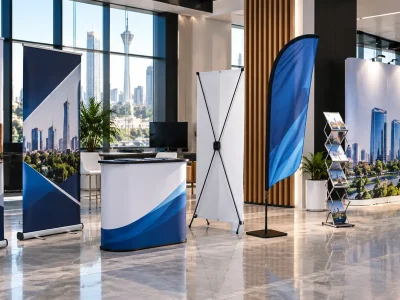
Production of mobile exhibition stands in Tashkent — order now
A mobile stand is a convenient solution for companies that need to quickly set up a presentation or promotional space…

Interior Branding for Business: Why a Brand Must Work Inside as Well as Out
Many companies invest in their facade and outdoor advertising but underestimate interior branding. Yet, it is inside the space where…

Signage Advertising Agency in Uzbekistan: Where to Order Effective Advertising
A signage advertising agency is a key partner for businesses in Uzbekistan that aim to attract customers offline on a…

REQUEST A CALL
Leave a request. Our managers will contact you soon and calculate the cost of your project.